Guide to Learning AI Agents
Note: the original deep link to the image/article was not provided. For a related, official resource see OpenAI Agents Guide, and for a friendly explainer on RAG see Pinecone’s RAG guide.
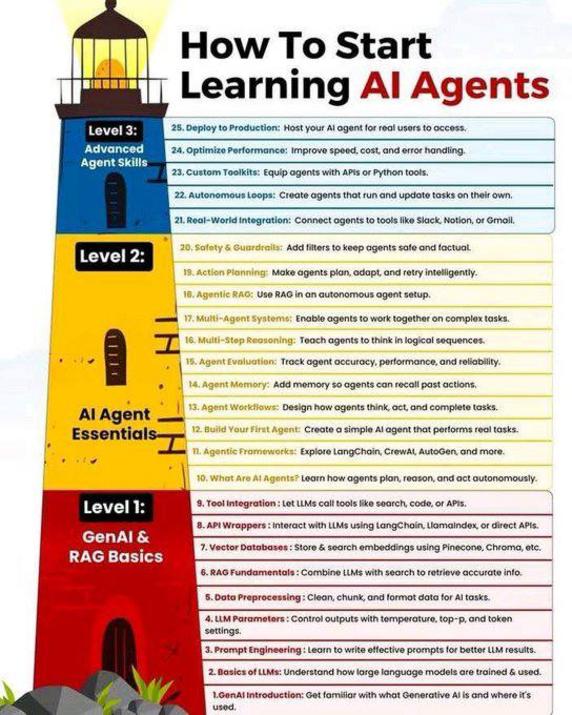
Imagine a lighthouse that teaches you to build AI agents, level by level, that’s exactly what this visual guide does, and I want to walk you through it like we’re standing on the shore together. The structure is simple, and that’s the point.
First, Level 1: GenAI & RAG Basics. This is your foundation, think of it like learning to read the map, and pack the right tools. You’ll learn generative AI fundamentals, retrieval-augmented generation, and simple prompts. I remember fumbling with prompts at first, one step felt tiny, then it clicked.
Next, Level 2: AI Agent Essentials. Here you combine skills, build workflows, add memory, and manage tools. It’s messy and fun. You’ll wire up agents that can perform multi-step tasks, and you’ll test both failures and wins. Real projects live here.
Finally, Level 3: Advanced Agent Skills. This is deployment, monitoring, and safety, where you take everything and make it reliable for users. You’ll learn scaling, observability, and guardrails, and yes, you’ll still iterate forever, because production throws surprises.
The lighthouse metaphor fits, because each level lights the way to the next, bright colors marking progress, and practical tasks showing what to try. If you’re an individual tinkerer or a professional building on a team, this guide gives a clear path, from simple experiments to robust deployments.
I’m optimistic about where agents are headed, and if you start with the basics and keep building, you’ll find yourself comfortable guiding others too. Want a quick next step? Skim a Level 1 checklist, try a small RAG prototype, and then celebrate the tiny wins.
Deutsch
Hinweis: Der ursprüngliche Deep Link zum Bild/Artikel wurde nicht bereitgestellt. Zur Orientierung siehe OpenAI Agents Guide und Pinecone zur RAG-Erklärung.
Stell dir einen Leuchtturm vor, der dir beim Lernen von KI-Agenten hilft, Stufe für Stufe, genau so ist diese Grafik aufgebaut. Das Bild ist praktisch und klar, mit drei Levels, jedes mit konkreten Aufgaben.
Level 1, GenAI & RAG Basics, ist die Startstufe. Du lernst generative Modelle, wie Retrieval-augmented Generation funktioniert, und erste Prompt-Techniken. Das sind die Werkzeuge, die du täglich brauchst, glaub mir, es lohnt sich, hier Zeit zu investieren.
Level 2, AI Agent Essentials, geht in die Praxis. Workflows, Gedächtnis, Tool-Integration, das alles gehört dazu. Hier baust du Agenten, die mehrstufige Aufgaben erledigen können. Es wird unordentlich, manchmal frustrierend, aber du siehst schnell Fortschritte.
Level 3, Advanced Agent Skills, ist für Produktion und Sicherheit. Deployment, Skalierung, Monitoring, und Schutzmaßnahmen gegen unerwartete Fehler. Das ist der Punkt, an dem Zuverlässigkeit zählt, besonders wenn echte Nutzer involviert sind.
Die Leuchtturm-Metapher passt gut, weil jeder Level Licht spendet und dich weiterführt. Ob du allein herumtüftelst oder im Team arbeitest, diese Struktur hilft dir, systematisch zu wachsen. Mein Rat: Starte klein, baue ein RAG-Projekt, lerne aus Fehlern, und skaliere dann schrittweise. Es macht Spaß, und du wirst überrascht sein, wie schnell sich lauffähige Agenten entwickeln.












Kommentar abschicken