How Cerebras Built Its Internal Knowledge Base
Enterprise knowledge bases usually don’t fail because people don’t need answers. They fail because we pretend company knowledge can live in one perfectly organized place.
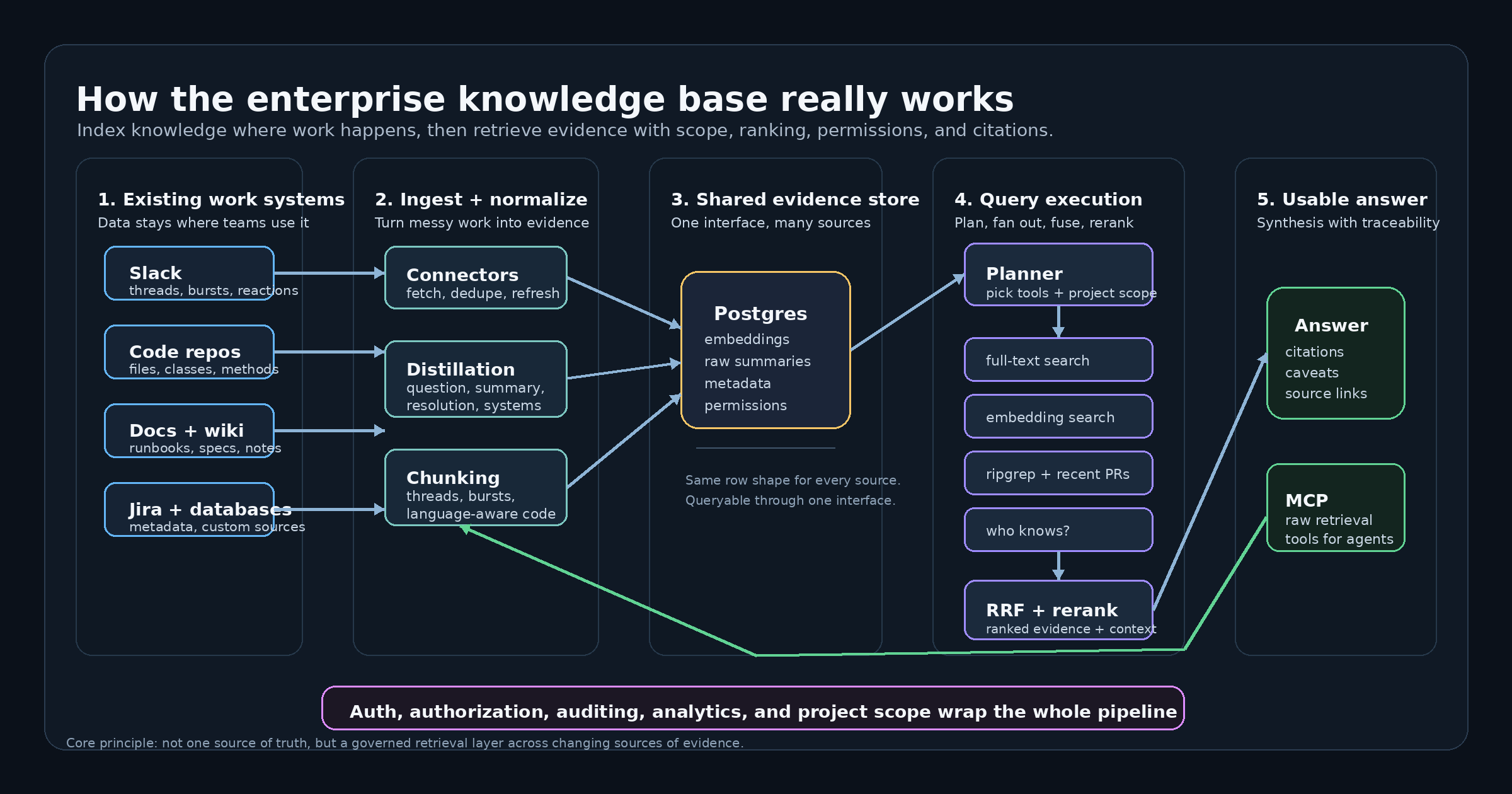
Cerebras’ write-up on its internal knowledge base is a good reminder that reality is messier, and better systems start by accepting that. Their internal assistant now handles more than 15,000 employee questions per day, only three months after launch. Impressive, yes. But the architecture is the useful part.
Instead of asking teams to abandon Slack, GitHub, Jira, docs, code repositories and internal databases, Cerebras built a retrieval layer across the places where work already happens. The system uses a shared Postgres embeddings table, hybrid retrieval, full-text search for exact matches, embeddings for semantic matches, IDF filtering to reduce low-signal noise, and age decay so fresh knowledge can outrank stale confidence.
That last detail matters more than it sounds. Anyone who has ever trusted an old Slack thread knows the feeling… technically searchable, practically dangerous.
The Slack pipeline is especially pragmatic. Threads are fetched as whole conversations, distilled into useful knowledge, then updated through incremental re-embedding. At query time, the system fans out across tools, fuses rankings, reranks evidence, restores surrounding context, and only then synthesizes an answer.
That is the real lesson here: useful enterprise AI is not one magical search box. It is a governed evidence pipeline across shifting sources of truth.
This also connects to the broader agent-systems pattern we keep seeing: the quality comes less from the final model flourish, and more from clean routing, structured context, retrieval discipline, and fewer vague handoffs.
The future of enterprise knowledge probably won’t be a single grand repository. It will be a well-governed retrieval layer over the places where truth keeps changing. Much less romantic. Much more useful.
Source: https://www.cerebras.ai/blog/how-we-built-our-knowledge-base






Kommentar abschicken