Overview of AI Disciplines (all credits to external source)
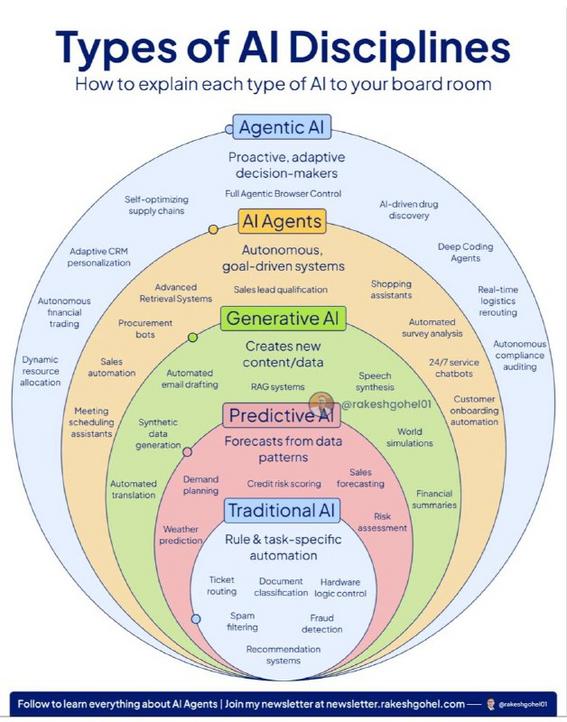
**Overview of AI Disciplines (all credits to external source)**
If you’ve ever felt a little lost in the world of AI, you’re not alone. One minute someone’s talking about chatbots, the next it’s predictive analytics, then suddenly “agentic systems” enter the conversation. It can feel like everyone else got the memo except you.
I recently came across a visual overview that breaks AI into four clear categories, and honestly, it’s the kind of explanation I wish I’d seen earlier. You can explore the original source here:
Let’s walk through it together.
First, there’s **Traditional AI**. This is the foundation. Think rule based automation. Spam filters in your inbox. Simple hardware logic controls. It follows clear instructions, like a recipe. If this happens, do that. Reliable. Structured. Not very flashy, but incredibly useful.
Then we move to **Predictive AI**. This is where data starts telling stories. By spotting patterns, it can forecast outcomes like credit risk or product demand. Imagine looking at years of sales data and saying, “We’re probably going to need more umbrellas next month.” That’s predictive AI quietly working in the background of many businesses.
Next comes **Generative AI**, the category most people are buzzing about. This is the creative one. It drafts emails, generates images, synthesizes speech. Instead of just analyzing data, it creates something new from it. If Traditional AI follows a recipe, Generative AI experiments in the kitchen.
And finally, **Agentic AI**. This is the most advanced layer. These systems don’t just analyze or create, they act with a degree of autonomy. Think self optimizing supply chains or AI driven drug discovery. It’s less about single tasks and more about pursuing goals.
What I appreciate about this layered view is its clarity. It shows AI not as one big mysterious thing, but as a spectrum of capabilities that build on each other.
As these disciplines continue to evolve, we’ll likely see them blend together in practical ways. And understanding the differences now? That gives you a real advantage in seeing where things are headed next.




Kommentar abschicken