The Prompting Playbook: Mastering LLM Interactions
The Prompting Playbook: Mastering LLM Interactions
If you’ve ever felt frustrated tweaking a prompt over and over again, hoping the model will “just get it,” you’re not alone. I’ve been there. You change a sentence, hit run, cross your fingers… and somehow the output gets worse.
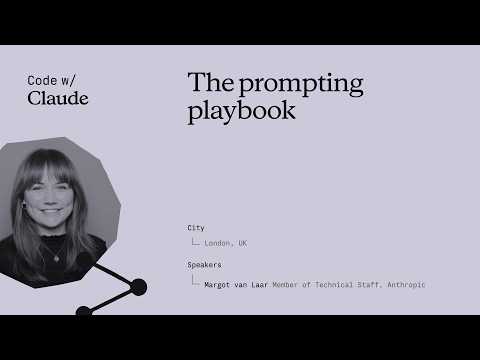
In The Prompting Playbook, Margot van Laar, Applied AI Engineer at Anthropic, walks through what actually works when dealing with Large Language Models. And it’s refreshingly practical.
She breaks it into two real-world scenarios. First, debugging a production prompt that suddenly starts failing, for example after a model migration. Instead of guessing, she recommends building a small evaluation set. Think of it like a test kitchen. You include normal cases, tricky edge cases, and situations that should escalate. Then you iterate carefully.
One of her examples involves a messy customer support bot prompt. The fix was not magic. It was structure. Using clear XML tags. Removing clutter. Defining an explicit output contract. Small, deliberate changes. And when the bot kept making calculation mistakes, the solution wasn’t to yell “be more accurate.” It was to integrate a calculation tool. Structure over wishful thinking.
Then she shifts to building something new, a staff scheduling agent. Here, she compares different approaches. A simple prompt. A bigger model. Adding self-checks. And finally a generate, evaluate, repair loop using separate prompts for each step. That multi-prompt system turned out to be more reliable and even more efficient.
What I love most is the mindset behind it. Start minimal. Test rigorously. Fix failures systematically. Add structure instead of more instructions.
If you’re working with LLMs, this isn’t just helpful. It’s grounding. It reminds you that prompting isn’t guesswork. It’s engineering. And as these systems become more embedded in our daily tools, that disciplined approach is going to matter more and more.






Kommentar abschicken